Viking Name Generator
This Viking name generator forges Old Norse names with patronymics and earned bynames — and it doubles as a converter: type your own name in and find out what your Viking name would be. Ever wonder what people would have called you a thousand years ago, axe in hand, sailing the cold northern seas? A Viking name is rarely just a name. It carries who your father was, and what you did to earn the word people whispered behind it.
👇 Click any name to copy it
This generator is built on real Old Norse naming patterns, simplified for speed. Leave the name field blank and pick a gender, a role, and a byname style, then roll. Type your own name in instead and it becomes a converter: the same input always returns the same result, so you can share it and a friend who tries the identical spelling gets an identical answer. Either way, you get a given name, a true patronymic ending in -sson or -sdóttir, and an earned byname like Ironside or the Bold. Click any card to copy it. No sign-ups, no tracking.
What Is My Viking Name? How the Converter Works
Punch your name into the field above the Generate button and the result stops being random. Under the hood, the generator hashes your exact spelling into a number, then uses that number — not the clock, not a dice roll — to pick your given name, your patronymic's father-root, your role, and your byname. Change one letter and you get a different person; keep the spelling identical and you get the same one back every time, on any device, on any day.
That matters more than it sounds like it should. A random name is fun for one roll and forgotten by the next. A name tied to your own spelling is something you can screenshot, put in a bio, or tell a friend to try for themselves — and it holds up, because the generator isn't guessing twice. This is the same approach behind our Wu-Tang name converter, adapted here for Old Norse structure instead of hip-hop aliases.
One honest caveat: this is not a linguistic translation. There's no Old Norse word that "Jordan" or "Priya" literally means, so the converter doesn't attempt one. What it gives you is a fixed, saga-shaped identity — a given name, a patronymic, and a byname — generated consistently from your name rather than pulled from thin air. If you want the real grammar behind the patronymic half of that identity, our Old Norse patronymics guide walks through how the genitive case actually builds a name like Eiríksson or Sturluson.
How Old Norse Names Worked
Most Vikings went by a single given name. What came after it told you where they stood. There were no family surnames the way we have them now — instead, a person carried a patronymic: their father's name with a suffix bolted on. A son added -sson, a daughter added -sdóttir. Erik's son Leif was Leif Eriksson. Erik's daughter Freydís was Freydís Eiríksdóttir. Every generation, the second name reset.
That patronymic did real work. It proved your line, your right to inherit land, and your place in the kindred. A thrall — a slave — had no patronymic, which is exactly how much it mattered. Sometimes a child took a matronymic instead, naming the mother, usually when she was the better-known parent.
Given names themselves were small statements. They stacked Old Norse roots — björn (bear), úlfr (wolf), víg (battle), frið (peace), dís (divine woman) — into a single word that meant something. Ragnar read as "counsel of the gods." Astrid meant "beautiful, beloved." These were short, heavy, and built to be shouted across a fjord.
Viking Epithets and Bynames, Explained
This is the part of a Norse name that does the most work, and it's the part most other generators treat as an afterthought. A byname (also called an epithet, and often what people mean when they search for a Viking nickname generator) is the most colourful piece of a Norse name, and the most honest. You did not pick it — you earned it, for a deed, a scar, a habit, or a story that followed you home. Some were flattering. Plenty were not.
Take the real ones. Erik Bloodaxe (Eiríkr blóðøx) carried that name for the kin he killed to hold a throne. Bjorn Ironside (Björn Járnsíða) earned his in battle, walking out unmarked as though his skin were iron. Harald Fairhair united Norway, and the hair was the dullest thing about him. And Ragnar Loðbrók — "Hairy-Breeches" — reminds you the Norse were happy to laugh at a legend. The generator offers four byname styles so you can match the tone you want, and our guide to epithets, titles, and bynames goes deeper into why these three name types are constantly confused for each other.
Bynames didn't come from nowhere — they clustered into a handful of recognizable types, and knowing them helps you pick (or write) one that actually fits your character instead of just sounding cool.
| Byname type | What it marks | Examples on this page |
|---|---|---|
| Appearance | A visible physical trait, for better or worse | Fairhair, the Red, the Tall |
| Deed / character | A specific act or a defining trait people remembered | Bloodaxe, Ironside, the Bold, the Boneless |
| Skill / role | What the person did — protect, sail, sing, foresee | Oak-Shield, War-Singer, Watcher of Fjords |
| Place / origin | Where the person came from, sailed to, or made a name | of Vestfjord, of Frostwatch, the Far-Sailed |
| Blunt / mocking | A plain, sometimes unkind jab — earned, never chosen | Hairy-Breeches (Loðbrók), the Boneless |
That last row is the one modern retellings tend to soften. Old Norse audiences were happy to record an unflattering byname right alongside a heroic one, because the point was never flattery — it was recognition. If two men in the same hall were both named Ketil, the byname was what let you tell them apart, whether it praised or mocked. Our bynames guide covers how a handful of these blunt, practical labels eventually hardened into modern surnames — and why most of them never did.
| Byname style | The vibe | Example |
|---|---|---|
| Classic Norse | Sturdy honours of strength and loyalty | Oak-Shield, the Bold, Bear-Heart |
| Anglicized | Smoother, traveller's tongue | the Steadfast, the Far-Sailed |
| Fierce / Warrior | Battle-earned and a little fearsome | Bloodaxe, Ironside, Wyrm-Bane |
| Poetic / Saga | The skald's flourish, half a kenning | Watcher of Fjords, Friend of Storms |
Name Forms: What Each Part Adds
The generator builds a name in layers. Start with the given name, then stack on a patronymic, a byname, or both. Here is what each choice does and how it reads.
| Name form | What it adds | Example |
|---|---|---|
| Given name only | The core name, nothing else — clean and saga-plain | Sigurd |
| Given + patronymic | Names the father with -sson / -sdóttir | Sigurd Haraldsson |
| Given + epithet | Adds an earned byname instead of a parent | Sigurd Ironside |
| Full | Given name, patronymic, and byname together | Sigurd Haraldsson the Bold |
Do Vikings Have Surnames? The Honest Answer
People land on this page searching for a Viking surname generator, a Viking last name generator, a Norse surname generator — different words for the same question. The honest answer is that Vikings did not have surnames the way you mean it. Nobody in the Viking Age inherited a fixed family name that stayed put across generations. What they had instead was two separate systems, and this generator builds both.
The first is the patronymic you've already read about above — Eriksson, Haraldsdóttir — which names a parent and resets every single generation. Leif's children were never "Eiríksson"; they were patronymically named for Leif himself. That's the closest thing to a "last name" a Viking carried, and it's not really a last name at all, since it changes every time someone has a child.
The second is the byname from the section above — Bloodaxe, Ironside, the Boneless. That's what "Viking nickname generator" searches are usually after, and it's personal and non-hereditary: nobody's children inherited "Bloodaxe" as a family brand. So when this page's generator gives you "Sigurd Haraldsson the Bold," you're not getting a first name and a surname. You're getting a given name, a statement about your father, and an earned reputation — three different jobs, none of which is the job a modern surname does. For the full grammar behind why — including the real genitive-case rule that "just add -sson" gets wrong — read our Old Norse patronymics guide.
How to Use Viking Name Generator
Four controls shape every name. Set a gender — male, female, neutral, or let it roll. Choose a role to colour the result: a raider leans fierce, a jarl reads stately, a seer turns poetic, a shieldmaiden carries an edge. Pick a byname style, or leave it on match role and let the role decide. Then choose the name form — how much of the patronymic-and-byname stack you want.
Use the slider for how many names to roll, then hit Generate. Each card shows the name, a role badge, a line of context, and sometimes a place of origin like of Frostwatch. Don't like the batch? Roll again as often as you want, and click any card to copy it to your clipboard.
Viking Roles and the Names That Fit Them
The Norse world was not all raiders. A name sat differently depending on the life behind it, so the generator tilts each result toward the role you choose.
- Raider – Sailed for plunder and a saga worth telling. Fierce bynames suit them: Bloodaxe, Skull-Cleaver, Raven-Caller.
- Jarl – A chieftain holding land, oaths, and a longhall of followers. Classic honours fit: the Bold, Oak-Shield, Fairhair.
- Seer (Völva) – Read runes and the will of the Norns, feared and honoured at once. Poetic bynames suit the part: Watcher of Fjords, Breaker of Silence.
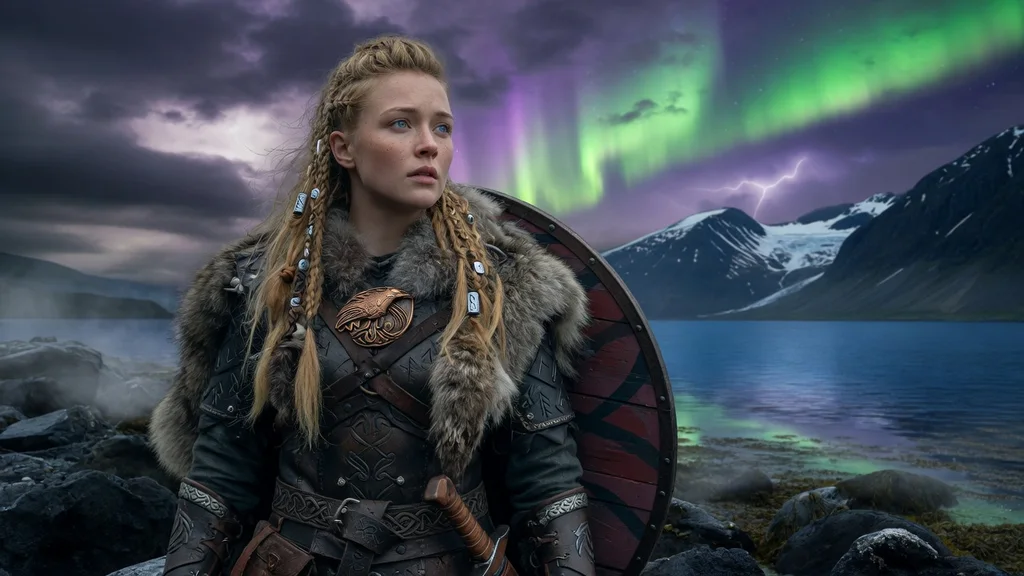
- Shieldmaiden – Took up axe and shield in the wall beside the men. A fierce byname lands as hard for her as for any raider.
Female Viking Names
Set the gender filter to female and everything above still applies — given name, real patronymic, earned byname — built from a dedicated pool of Old Norse women's names rather than a male name with an -a bolted on. Astrid ("beautiful, beloved"), Freya (the goddess's own name), Sigrid ("beautiful victory"), and Gudrun ("god's secret lore") are all names actually carried by Old Norse women, not modern inventions dressed up in old spelling.
The patronymic works exactly the same way for daughters: -sdóttir instead of -sson, naming the same father. Sigrid, daughter of Harald, is Sigrid Haraldsdóttir — grammatically identical to her brother's Haraldsson, just the other suffix. And bynames landed on women as often as men in the sagas: shieldmaidens earned fierce ones, völur (seers) earned poetic ones, and plenty of ordinary women earned blunt, funny, or flattering ones for the same reasons men did. Nothing about the byname system was gender-locked — a woman's reputation got a word just like a man's did.
Viking Name Generator vs. Old Norse Name Generator
"Viking" and "Old Norse" get used almost interchangeably in casual searches, but they're not quite the same angle, and it's worth knowing which one you actually want. A Viking was someone who went raiding or trading overseas — a specific activity, not an ethnicity or a time period by itself. Old Norse is the language and the broader culture that produced Vikings, farmers, skalds, and settlers alike, most of whom never set foot on a longship.
This generator leans into the Viking angle: given name, patronymic, earned byname, tilted toward raiders, jarls, seers, and shieldmaidens. Our separate Old Norse name generator takes the other angle — it skips the patronymic-and-byname stack entirely and draws straight from curated pools of mythic, heroic, and everyday attested names with real documented meanings. If you want the full three-part identity of a raider or a jarl, stay here. If you want a single standalone name with a clean, sourced meaning — for a homestead farmer, a background NPC, or just the name itself — that generator is the better fit.
Example Viking Names
Male Names
- Ragnar Iron-Hand
- Erik Wolf-Friend
- Ulf the Bold
- Sigurd Haraldsson
- Bjorn Ironside
- Harald Fairhair
- Leif Eriksson
- Gunnar Bloodaxe
- Hakon the Tall
- Sven Skull-Splitter
- Ivar Storm-Born
- Knut Sea-Strider
Female Names
- Freya Storm-Born
- Astrid the Red
- Ingrid Oak-Shield
- Sigrid Haraldsdóttir
- Gudrun Frost-Warden
- Thora Raven-Caller
- Aslaug Seeker-of-Sagas
- Brynja Ironside
- Helga the Swift
- Ragnhild War-Singer
- Saga Watcher-of-Fjords
- Tyra Bear-Heart
Bynames and Epithets
- Bloodaxe
- Ironside
- the Bold
- Fairhair
- Skull-Cleaver
- Oak-Shield
- Wolf-Friend
- Storm-Born
- Raven-Caller
- the Boneless
- Sea-Strider
- Watcher of Fjords
Byname Meanings
Old Norse bynames packed a whole story into one word. Many survive in the sagas with their meanings intact; others here are interpretive, built in the same spirit. Use this as a quick reference when you pick a style above.
| Byname | What it says | Style |
|---|---|---|
| Bloodaxe | A killer's reputation, kin-blood and all | Fierce |
| Ironside | Walked out of battle unmarked, as if iron-skinned | Fierce |
| the Boneless | Uncanny, hard to pin down — a real saga byname | Fierce |
| Fairhair | Marked by looks, but known for uniting a realm | Classic |
| the Bold | First into the fight, last to flinch | Classic |
| Oak-Shield | Steadfast, the one others stood behind | Classic |
| Wolf-Friend | Loyal and fierce, runs with the pack | Classic |
| the Far-Sailed | Crossed more sea than most see in a life | Anglicized |
| Watcher of Fjords | A skald's line — keeper of the coast and its stories | Poetic |
| Friend of Storms | Unbothered by weather that breaks lesser sailors | Poetic |
| Raven-Caller | Read omens in the birds that followed a raiding fleet | Fierce |
| Storm-Born | Said to have come into the world during a wild sea-storm | Classic |
| the Stout | Built solid, hard to knock down in a shield-wall | Anglicized |
| Skull-Cleaver | Blunt battle reputation, no metaphor needed | Fierce |
Tips for Choosing a Viking Name
A good Norse name should sound like it has a past. Use these to pick yours:
- Say it out loud – Norse names are built for the ear. If it lands hard and clean when you shout it, it works.
- Match the byname to a deed – Bynames were earned. Pick one that hints at a story, not just a sound you like.
- Keep the patronymic honest – Eriksson, Haraldsdóttir. It names a parent, so let it read like one rather than a random tag.
- Lean on the role – A jarl and a raider carry their names differently. Let the role steer the style and the name writes its own backstory.
- Don't overstack – A full given-patronymic-byname name is grand, but a single given name can hit just as hard. Use the weight when the moment calls for it.
- Add the runic letters by hand – Want extra flavour? Swap in æ, þ, ð, or ø where they belong. Just keep it readable for the people who'll say it.
What People Use Viking Names For
These names travel well. Writers grab them for fantasy and historical fiction because they feel lived-in from the first read. Gamers drop them into Skyrim, Valheim, and D&D campaigns, or wear them as online handles — Runa Iron-Hand beats Jane1234, and you know it. Reenactors and cosplayers use them for authenticity, sometimes carving them onto a shield. Even a family cat has answered to Bjorn the Small. There's something grounding about borrowing a name from a world that felt larger than life.
Shores of the North
FAQ for Viking Name Generator
What is my Viking name?
Type your name into the box above the generator and hit Generate — the tool turns it into an Old Norse given name, a real patronymic, and an earned byname, the same combination every time you enter that exact name. It's a translation in spirit, not a literal one: there's no dictionary that maps "Jordan" to an Old Norse word, so the generator gives you a plausible saga-era identity keyed to your name instead of a random one.
What would my Viking name be if I lived a thousand years ago?
Probably a single given name most of your life, then a patronymic once anyone needed to tell you apart from another person with the same name, and maybe a byname if you did something — or looked like something — worth talking about. The converter above compresses that into one instant result; the sections below explain the real mechanics behind each piece.
Does this Viking name generator work from your name, not just randomly?
Yes. Leave the name field empty and it rolls at random from gender, role, and style filters. Type your name in and it switches to a fixed result for that exact spelling — a converter, not a dice roll. Both modes use the same underlying pools of Old Norse roots, patronymics, and bynames.
What does -sson or -sdóttir mean in a Viking name?
It marks who your father was. A son took the father's given name plus -sson, a daughter took it plus -sdóttir. So Leif, son of Erik, was Leif Eriksson, and Freydís, daughter of Erik, was Freydís Eiríksdóttir. There were no inherited family surnames — your second name changed every generation.
Do Vikings have last names or surnames?
Not in the modern sense. "Viking surname generator" and "Viking last name generator" searches usually want one of two things this page actually gives you: a patronymic (a name built from your father, like Eriksson) or a byname (an earned nickname, like Bloodaxe). Neither one is inherited the way a modern surname is — see the honest answer further down this page.
What is a Viking byname or epithet?
A byname is a nickname earned through deed, looks, or reputation — never inherited. Some were honours (Ironside, Fairhair), some were blunt or mocking (Bloodaxe, the Boneless, Hairy-Breeches). The generator can append one in four styles, from classic to fierce to saga-poetic.
Is there a Viking nickname generator here too?
Yes — "byname" is the historical term for what most people search for as a Viking nickname. Set the name form to "Given + epithet" and pick a style, and the generator hands you an earned-sounding nickname on its own, without a patronymic attached.
Where can I use the Viking name generator?
Anywhere you need a name with real Old Norse structure — a tabletop character, a Skyrim or Valheim save, historical fiction, a reenactment persona, or a gaming handle. Because it builds proper patronymics and earned bynames instead of random fantasy syllables, the result reads like it survived in a saga.
Are these names historically accurate?
They are built on authentic Old Norse roots and the real patronymic and byname patterns, then mixed for variety and readability. Think of them as plausible saga-era names rather than copies of specific historical figures. For the deeper grammar — including where a simple "add -sson" rule breaks down — see our Old Norse patronymics guide.
Did Viking women have second names too?
Yes. Women carried a patronymic with -sdóttir, and could earn bynames just like men. Shieldmaidens and seers appear across the sagas, so a fierce or poetic byname fits them as naturally as it fits a raider. Set gender to female for names and patronymics built the same way.
What's the difference between a Viking name generator and an Old Norse name generator?
This page is built around the patronymic-and-byname system — the naming grammar Vikings actually used. Our separate Old Norse name generator skips that structure entirely and draws from curated pools of mythic, heroic, and everyday attested names instead. Use this one for the full given-plus-patronymic-plus-byname stack; use that one for a standalone name with a documented meaning.
Where do Viking names come from?
From Old Norse itself — a language that stacked roots like björn (bear), úlfr (wolf) and víg (battle) into given names that meant something. Bynames were earned through deeds rather than inherited, and a patronymic named a parent instead of a family line. The generator draws on those same roots and patterns rather than inventing new sounds.
Can I use these names in games and stories?
Freely. They suit Skyrim, Valheim, D&D campaigns, fantasy fiction, reenactment, and online handles. No rights or permissions needed — generate, click a name to copy it, and use it.
What about the special letters æ, þ, ð, and ø?
Those are Old Norse characters. Spelling out names plainly (Thora, not Þóra) keeps them pronounceable for modern readers, which is what this generator does by default. Add the runic-looking letters by hand if you want extra authenticity.